



In 2026, the mobile app ecosystem is evolving faster than ever, driven by smarter technology, user-centric design, and powerful connectivity. Businesses and developers across the world are adapting to new expectations, from intelligent experiences to super-fast performance and heightened security. Here’s a detailed look at 10 key mobile app development trends that are shaping the future and redefining how apps will be built, used, and valued in 2026.
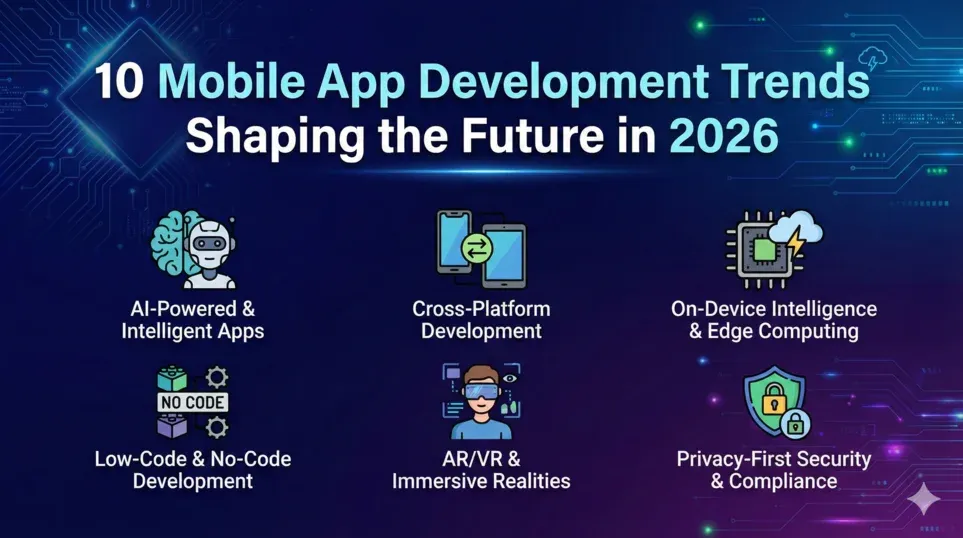
What are the ten Mobile App Development Trends To Consider in 2026
1. AI-Powered and Intelligent Apps
Artificial Intelligence (AI) and Machine Learning (ML) are key components of new apps. Mobile apps are predicted to be highly integrated with AI by 2026. Mobile apps will be able to offer hyper-personalized experiences and make predictions about user behaviors, which will allow them to automate decisions. Intelligent systems will personalize content, notifications, and features to keep users engaged and to improve retention rates.
Anticipating user needs, optimizing recommendations, and providing immediate help via intelligent assistants are all features that apps will offer. AI will likely offer more than basic chat functions and will offer more complex automated features.
2. Cross-Platform Development Dominates
More and more developers are choosing cross-platform frameworks like Flutter, React Native, and Kotlin Multiplatform. These frameworks are able to let development teams maintain a single codebase that can be utilized across all platforms (Android, iOS, Web) without compromising performance or user experience. This is a great way to reduce costs while also speeding up development in an era where businesses need to get apps published.
You might be interested in : Top 10 Cross-Platform App Development Frameworks
More enterprise app development companies are choosing cross-platform solutions so they can streamline their user experience across all devices and save time and effort.
3. On-Device Intelligence and Edge Computing
More computation will take place on the device itself rather than sending all data to the cloud. Devices with on-device AI provide faster responses, greater privacy, and better offline capabilities than cloud AI. Tasks such as speech recognition, image categorization, and analytics prediction will be completed without the need for constant network availability.
With data privacy, the computation will be done faster, and the device will be better optimized without the need for remote servers, reducing backend infrastructure costs.
4. Low-Code and No-Code App Development
App creation will be done in a greater acceleration in the year 2026. Businesses will be able to prototype and construct complete working mobile applications with little technical knowledge, thanks to low-code/no-code platforms. Drag-and-drop elements, visual builders, and template libraries will reduce the time needed for the development process and promote faster testing cycles.
While conventional programming is still fundamental for complicated systems, linear and no-code platforms are particularly beneficial for minimum viable products (MVPs), internal applications, and testing in the market.
5. Rise of Super Apps and All-In-One Experiences
The concept of super apps, platforms that bundle many services into one mobile interface, is expanding beyond Asia into global markets. Super apps combine social networking, payments, shopping, messaging, and on-demand services into one seamless experience.
This trend is driven by user demand for convenience and consolidation, reducing the need to switch between multiple apps for different tasks.
6. AR/VR and Immersive Realities
Retail, gaming, education, and navigation applications are being flooded with Augmented Reality (AR) and Virtual Reality (VR) applications as these two technologies shift away from the niche markets. Users are able to visualize products in real space, and use virtual try-on, and some AR apps that superimpose useful information in a real-time view of the real world.
Mobile apps are predicted to use AR for more than just entertainment in 2026 and will offer more sophisticated ways to engage with users.
7. 5G and High-Speed Connectivity
5G networks expanding coverage offer new app use cases, as apps can do more heavy-lifting with data and ultra-low latency. The use of real-time collaboration, HD streaming, cloud gaming, and IoT integration will all provide seamless experiences.
5G networks provide app developers with more opportunities to offer sophisticated graphic features and improved back-end communication, resulting in improved mobile experiences.
8. Privacy-First Security and Compliance
The expansion of mobile applications means more user data is being harvested. Therefore, the app user data collection process needs to be more secure and private. In app developer practices, user data is protected through end-to-end user data encryption, minimal data collection, secure authentication, and data protection practices that comply with global laws.
In relation to sensitive data, such as finance, health care, and personal/profiles, trust through control and accessible data protection transparency is now a competitive advantage.
9. Voice and Conversational Interfaces
In 2026, voice-first technologies will be part of nearly every single mobile application because they will enhance mobile user experience with the convenience of hands-free operation.
Voice UIs and Conversational UIs will be able to perform voice commands, complete tasks, and assist in workflow, augmenting the user experience with features that eliminate the need to touch the screen.
10. Progressive Web Apps (PWAs) and Accessibility
Progressive Web Apps (PWAs) load FAST, work OFFLINE, and do not require an APP STORE installation. Therefore, they provide a reliable solution to the challenges that areas with limited bandwidth and storage face.
From an added user developer experience and resource allocation viewpoint, they add tremendous value to small businesses and startups because they do not require a large development budget. PWAs offer app-like functionality through browser offerings.
Conclusion
Mobile app development trends in 2026 are all about intelligence, connectivity, and user empowerment. From AI-driven personalization to universal platforms like super apps and immersive AR experiences, the future of mobile apps will be smarter, faster, more secure, and more engaging than ever before. Developers and businesses that embrace these trends now will be better positioned to lead in a highly competitive digital landscape.
You might be interested in this topic as well:
1. WHY IS ARTIFICIAL INTELLIGENCE DEVELOPMENT CONSIDERED A TRANSFORMATIVE TECHNOLOGY?
2. CREATING INTERACTIVE AND USER-FRIENDLY FORMS: TIPS AND TRICKS
3. FREE WEB DESIGN RESOURCES WEBSITE TO BOOKMARK



Leave A Reply