
Imagine it’s 2015. You’ve just discovered jQuery.animate(). You feel like a wizard because you made a red box slide across the screen in 40 lines of code. Fast forward to 2026, and that red box isn’t just sliding. It’s reacting to the user’s scroll behaviour, morphing into a 3D glassmorphic sphere, and maintaining buttery-smooth 120fps on a mobile device.
The web has moved from static pages to “living” interfaces. But with dozens of tools available, which JS animation library should you actually stake your project on? Whether you’re building a high-converting e-commerce landing page or a complex data dashboard, the right choice determines if your site feels like a premium experience or a lagging relic of the past.
The Necessity of JS Animation in Modern Web
JavaScript animation is no longer a mere aesthetic enhancement. It is a critical component for delivering competitive, engaging, and accessible user experiences on the modern web. The primary reason for its necessity lies in enhancing user experience (UX). Smooth, meaningful transitions guide the user’s eye, provide immediate visual feedback on interactions, and create a sense of responsiveness that static pages cannot match. For instance, smooth animations during page load can mask latency, turning a potential frustration into a delightful waiting experience. Furthermore, animations are crucial for clarity and communication. They can illustrate relationships between different elements, explain complex data visualizations, or walk a user through a multi-step process intuitively, often more effectively than static text or images. When elements seamlessly morph or transition, the user gains context about how the site’s structure works.
Another compelling argument is related to brand and design identity. Custom JavaScript animations allow developers and designers to create unique, memorable, and distinctive visual styles that stand out from template and AI driven websites. This contributes significantly to brand recall and professional perception. Finally, the ability to leverage JavaScript for animation, rather than relying solely on CSS. This provides greater programmatic control, allowing for complex sequencing, physics-based effects, interaction-driven changes, and integration with dynamic data sources. This flexibility is indispensable for creating highly interactive and data-driven applications. While performance must always be considered to prevent overly complex or distracting experiences, the strategic deployment of JavaScript animation is a fundamental pillar of high-quality, modern web application development.
When to Use JS Animation Over CSS Animation and Its Benefits
While CSS animations are suitable for simple, isolated transitions (like hovers or basic fades), JavaScript animation libraries are essential for complex, interactive, and data-driven experiences.
Benefits and Use Cases for JS Animation
- Complex Sequencing and Orchestration: Use JS when you need to precisely chain, overlap, pause, reverse, or seek to a specific point in multiple animations, which is nearly impossible with standard CSS keyframe timing.
- Programmatic Control and Interactivity: JS is necessary for animations driven by dynamic data, user input (like drag-and-drop), or complex logic that CSS cannot handle, such as physics-based spring effects or custom easing functions.
- Animating Non-CSS Properties: JS can animate properties beyond standard CSS (e.g, SVG paths, WebGL, Canvas objects, or properties within modern frameworks like React and Vue js).
Cross-Browser Reliability: Professional-grade JS libraries are engineered for superior reliability and cross-browser compatibility, ensuring smooth, frame-rate-independent playback (often 60 FPS) across devices, where complex CSS can become “janky”.
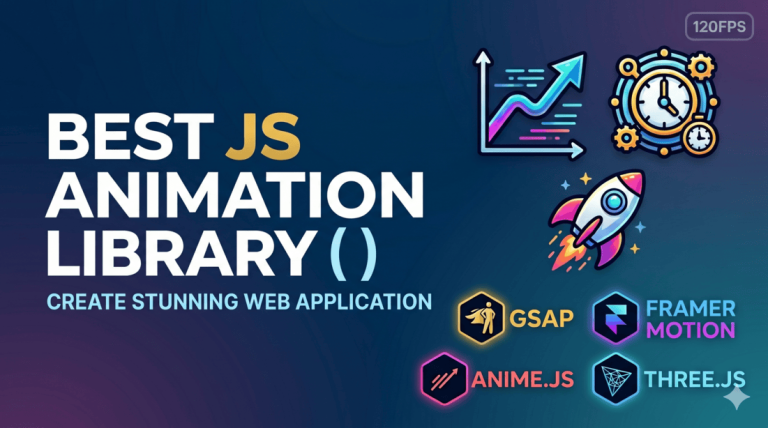
The list of best JS animation library
1. GSAP
The GreenSock Animation Platform (GSAP) is widely regarded as the best js animation framework. It follows industry-standard, professional-grade animation library. Known for its unparalleled reliability, cross-browser compatibility, and exceptional performance. GSAP’s core strength is its ability to animate virtually anything that JavaScript can touch including CSS properties, SVG elements, Canvas objects, and properties within modern front-end frameworks like React and Vue js.
This universal compatibility makes it the go-to solution for complex projects where animation needs to transcend standard HTML/CSS. Unlike many other libraries, GSAP is built from the ground up to guarantee smooth, frame-rate-independent playback, ensuring that complex sequences run reliably across all major browsers and devices. Its feature set includes advanced tools crucial for professional motion design. The Timeline feature allows for precise sequencing, overlapping, and manipulation of multiple animations. The MotionPathPlugin enables elements to follow custom vector paths, and other plugins offer sophisticated physics simulations and morphing capabilities. While it maintains a reputation for being robust and feature-rich, its API remains intuitive, allowing for rapid development of anything from simple UI feedback to elaborate interactive storytelling and cinematic web experiences.
Benefits:
- Widely regarded as the industry-standard, professional-grade animation library.
- Offers unparalleled reliability, guaranteed cross-browser compatibility, and exceptional performance.
- Ability to animate virtually anything JavaScript can touch (CSS, SVG, Canvas objects, and properties within modern frameworks).
- Built to guarantee smooth, frame-rate-independent playback for complex sequences.
- Includes the advanced Timeline feature for precise sequencing, overlapping, and manipulation of multiple animations.
2. Three.js
Three.js is arguably the most recognized and powerful JavaScript library for developing and rendering 3D computer graphics directly within a web browser, leveraging the capabilities of WebGL. Its primary value lies in offering a high-level API that effectively abstracts the complex, low-level mechanics of WebGL, which itself is a JavaScript API for rendering high-performance interactive 2D and 3D graphics. This abstraction simplifies the process of setting up scenes, cameras, lighting, and meshes, making 3D accessible to a broader range of web developers. Developers use Three.js to build everything from immersive product configurators and interactive data visualizations to full-scale 3D games and virtual reality (VR) or augmented reality (AR) experiences.
A key feature is its comprehensive ecosystem, which includes support for various rendering techniques, shaders, post-processing effects, and an extensive collection of loaders for different 3D model formats (like GLTF, OBJ, and FBX). Furthermore, it manages critical elements such as texture mapping, materials, and complex geometric calculations, all while striving for optimization to maintain smooth performance, which is vital when dealing with complex polygonal structures and real-time rendering. The library’s immense popularity, evidenced by its large star count, fosters a vibrant community and ensures continuous updates and a vast array of tutorials and third-party tools, cementing its position as the standard bearer for 3D web graphics.
Benefits:
- Most powerful for developing and rendering 3D computer graphics.
- Offers a high-level API that abstracts complex, low-level WebGL mechanics.
- Simplifies the process of setting up scenes, cameras, lighting, and meshes.
- Features a comprehensive ecosystem for shaders, post-processing effects, and loaders for various 3D model formats.
- Immense popularity and a vibrant community ensure continuous updates and vast resources.
3. Anime.js
Anime.js stands out as a lightweight, flexible, and powerful JavaScript animation engine favored for its simplicity and versatility. Its clean, intuitive API allows developers to target and animate virtually any property on the web, including standard HTML elements, CSS properties (like transformations and colors), SVG, raw JavaScript objects, and complex DOM attributes.
This broad compatibility makes it an excellent choice for a wide variety of tasks, from micro-interactions and interface feedback to complex sequence-based motion graphics. One of its most praised features is the built-in staggering system, which simplifies creating ripple effects or sequential animations across multiple elements with minimal code for instance, animating individual letters in a word or items in a list one after another. Control is paramount in Anime.js. It offers comprehensive playback controls (play, pause, restart, seek) and supports callbacks (on-start, on-complete, on-update) which are crucial for synchronizing animations with other application logic or chaining complex sequences together. The library provides an extensive range of customizable easing functions, enabling developers to fine-tune the pacing of motion, resulting in animations that feel natural and polished, significantly enhancing the overall user experience without being overly complicated or resource-intensive.
Benefits:
- Lightweight, flexible, and powerful JavaScript animation engine.
- Clean, intuitive API for animating virtually any property (HTML, CSS, SVG, raw JS objects).
- Features a built-in staggering system to simplify sequential animations across multiple elements.
- Offers comprehensive playback controls (play, pause, restart, seek) and supports crucial callbacks (on-start, on-complete).
- Provides an extensive range of customizable easing functions for natural and polished motion.
4. Lottie
Lottie is revolutionary because it bridges the gap between sophisticated design tools and web development by allowing developers to use complex, high-fidelity animations created in Adobe After Effects without the need to manually recode them in JavaScript or CSS. The workflow involves designers creating motion graphics in After Effects, exporting them as a lightweight JSON file using the Bodymovin plugin, and then using the Lottie library (specifically lottie-web) to render these vector-based animations natively across various platforms, including web, iOS, and Android.
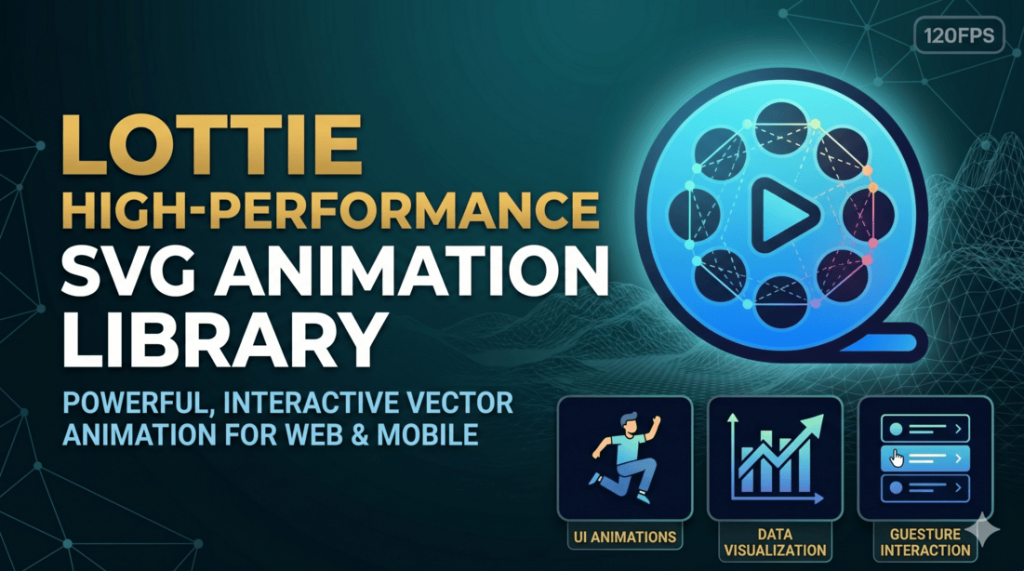
The sheer power of Lottie lies in maintaining the artistic nuance and complexity of the original After Effects animation, including intricate path animations, masks, and complex timing, which would be extremely time-consuming and difficult to replicate manually with code. Since the animations are vector-based and stored in JSON, they are incredibly small in file size and scale perfectly to any screen resolution without loss of quality, leading to highly performant and resolution-independent motion graphics. This capability streamlines the design-to-development pipeline, empowering teams to integrate rich, engaging, and expressive motion design, often used for loading screens, empty state illustrations, onboarding tutorials, and micro-interactions, significantly elevating the aesthetic and professional quality of an application.
Benefits:
- Bridges the gap between sophisticated design tools (Adobe After Effects) and web development.
- Maintains the artistic nuance and complexity of the original After Effects animation.
- Animations are exported as lightweight vector-based JSON files.
- Animations are scalable and maintain quality across any screen resolution.
- Streamlines the design-to-development pipeline for rich, engaging motion design.
5. ScrollReveal
ScrollReveal is a dedicated library focused on enhancing the visual appeal and storytelling capacity of a website by animating elements as they become visible in or disappear from the user’s viewport. This technique, often referred to as “reveal on scroll” or “scroll-triggered animation,” is pivotal in creating dynamic, modern websites that hold the user’s attention. The library is renowned for its dead-simple setup and intuitive API, allowing developers to add subtle yet impactful effects like fades, slides, and rotations to target elements with minimal code.
Despite its ease of use, ScrollReveal is built to be robust and flexible. It handles complex aspects like container scrolling, deferred initialization, and dynamic content loading automatically. Developers can define precise configurations for each element or apply global settings, controlling aspects such as the animation distance, duration, delay, and easing curve. Crucially, the library is optimized for performance; it uses efficient techniques to monitor scroll position and triggers animations with CSS transforms and opacity changes, ensuring they run smoothly at 60 frames per second (FPS) even on less powerful devices. This focus on performance, combined with its accessibility and ability to quickly implement engaging scroll-based interactions, makes ScrollReveal a cornerstone for developers looking to inject life and responsiveness into their site’s layout and content presentation.
Benefits:
- Enhances visual appeal and storytelling by animating elements as they enter the user’s viewport (“reveal on scroll”).
- Renowned for dead-simple setup and an intuitive API for quickly adding impactful effects like fades, slides, and rotations.
- Robust and flexible, automatically handling complex aspects like container scrolling and deferred initialization.
- Allows developers to define precise configurations for animation distance, duration, delay, and easing curve.
- Optimized for performance, running animations smoothly at 60 FPS using efficient CSS transforms and opacity changes.
6. Popmotion
Popmotion is accurately described as a tiny but mighty animator’s toolbox, serving as a low-level, functional animation utility that empowers developers with fine-grained control over motion. Unlike some monolithic libraries, Popmotion is modular, allowing developers to import only the necessary functions, which keeps the bundle size exceptionally small. Its core strength lies in its support for sophisticated animation methods, notably keyframe animations and physics-based spring simulations. Keyframe support allows for precise control over motion across specified points in time, while spring physics enables highly realistic and satisfying movements, where elements react dynamically to velocity and tension, mimicking natural physical behavior.
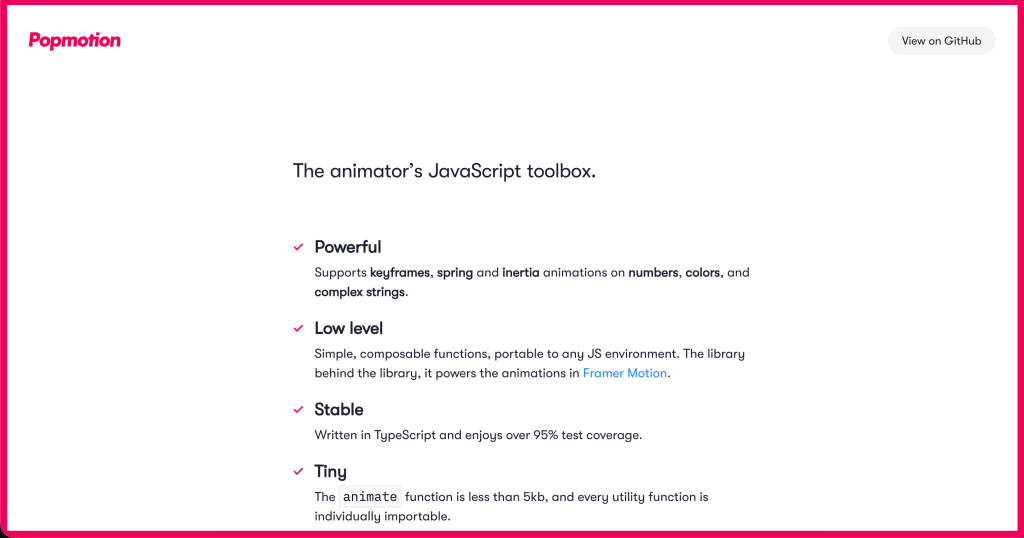
Popmotion can animate primitive values such as numbers and colors, but also complex string formats like SVG paths or CSS box-shadows, using a feature called ‘value types.’ Because it operates on underlying numerical values, it is completely framework-agnostic and can be used to drive animations in React, Vue, Svelte, or vanilla JavaScript, and even to control non-DOM elements like WebGL properties or game loops. This versatility makes it an indispensable tool for developers who require a highly customizable, performant, and low-footprint solution for building custom animation engines, micro-interactions, or integrating motion into custom UI frameworks.
Benefits:
- Modular architecture, allowing import of only necessary functions, which keeps the bundle size exceptionally small.
- Supports sophisticated animation methods, notably keyframe animations.
- Enables highly realistic and satisfying movements via physics-based spring simulations.
- Completely framework-agnostic and usable to drive animations in React, Vue, Svelte, or vanilla JavaScript.
- Can animate primitive values and complex string formats like SVG paths or CSS box-shadows using ‘value types’.
7. Mo.js
Mo.js is a dedicated, open-source motion graphics library specifically designed for creating stunning, complex web animations with a focus on visual effects and expressive movement. It goes beyond typical DOM manipulation by providing a set of powerful, built-in components that facilitate the creation of unique, graphical animations from the ground up. These components include Shape for animating basic geometric figures, Swirl for rotational and spiraling effects, and Burst for creating explosive, particle-based animations, which are incredibly useful for success messages, celebratory feedback, or dynamic button clicks.
Furthermore, it includes tools for animating HTML elements and complex staggering sequences, similar to other libraries but integrated within its motion-focused ecosystem. Mo.js is designed to make the process of crafting intricate, high-quality motion graphics feel intuitive and natural, employing declarative APIs that allow developers to describe the final state rather than meticulously managing every frame. Its use of vector graphics and its focus on performance ensure that these elaborate effects run smoothly, making it a favorite for adding delightful visual polish and high-impact micro-interactions to interfaces without requiring heavy external dependencies or sacrificing load times. The library’s focus on shape and particle animation distinguishes it from general-purpose animation libraries.
Benefits:
- Dedicated motion graphics library for creating stunning, complex web animations with a focus on visual effects.
- Provides powerful, built-in components like Shape, Swirl, and Burst for creating explosive, particle-based animations.
- Employs declarative APIs that make crafting intricate, high-quality motion graphics intuitive and natural.
- Use of vector graphics and focus on performance ensure smooth execution of elaborate effects.
- Excellent for adding delightful visual polish and high-impact micro-interactions to interfaces.
8. Velocity.js
Velocity.js was engineered as a high-performance, feature-rich animation engine intended to supplant or significantly outperform jQuery’s built-in $.animate() function, while simultaneously offering the declarative power often associated with CSS transitions. Its core innovation lies in its exceptional speed, achieved through careful optimization, often running animations faster and more smoothly than traditional CSS-based transitions, especially in older or less optimized browsers.
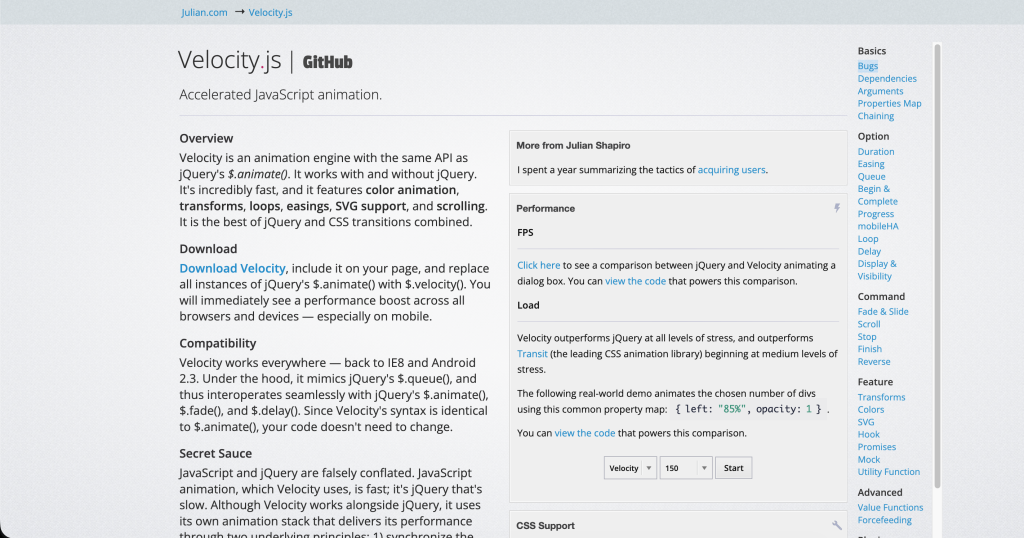
Velocity achieves this high performance by internally caching values, minimizing DOM manipulation, and focusing on GPU-accelerated properties like CSS transforms and opacity. The library boasts a broad feature set, capable of animating numerical properties, color values, complex CSS transforms, and SVG attributes. It includes support for intricate looping, custom easing functions (including Bezier curves and spring physics), and advanced sequencing, all exposed through a simple, fluent API that feels familiar to developers accustomed to jQuery, yet it can function entirely independently of jQuery, maintaining a lean footprint. Velocity remains a powerful choice for developers prioritizing high-speed, reliable, and expressive UI animations across a wide range of properties, making it ideal for large-scale, data-intensive applications where frame rate stability is paramount.
Benefits:
- Engineered for exceptional speed and high-performance, often outperforming traditional CSS-based transitions.
- Achieves smooth performance by minimizing DOM manipulation and focusing on GPU-accelerated properties.
- Combines the declarative power of CSS transitions with the feature richness of JavaScript animation.
- Boasts a broad feature set, animating numerical properties, color values, complex CSS transforms, and SVG attributes.
- Simple, fluent API is familiar to jQuery developers while maintaining a lean, independent footprint.
9. ScrollMagic
ScrollMagic is a powerful, yet focused, JavaScript library designed to facilitate the creation of complex, interactive, and time-based scrolling effects. It allows developers to define scenes where the animation’s progress is directly linked to the user’s scroll position, turning the scrollbar into a metaphorical video scrub tool. The two most celebrated features of ScrollMagic are its ability to trigger animations at specific scroll positions and to pin elements to the viewport for a set duration. Triggering can be used to start, reverse, or update animations (often leveraging external engines like GSAP for the actual rendering) as a user hits a certain point on the page. Pinning, on the other hand, is essential for creating fixed sidebars, sticky navigation, or ‘scrollytelling’ experiences where an element stays put while the content scrolls underneath it. By combining these features, developers can orchestrate intricate sequences that feel like cinematic experiences, guiding users through content in a controlled and highly engaging manner. Though the library is highly functional on its own, it is often paired with other robust animation libraries to handle the actual drawing, acting primarily as a sophisticated controller or orchestrator for scroll-based timing.
Benefits:
- Facilitates the creation of complex, interactive, and time-based scrolling effects.
- Allows developers to define scenes where the animation’s progress is directly linked to the user’s scroll position.
- Key feature is pinning elements to the viewport for a set duration, essential for fixed sidebars and sticky navigation.
- Enables the orchestration of intricate sequences that feel like cinematic ‘scrollytelling’ experiences.
- Highly functional as a sophisticated controller, often paired with other robust animation libraries to handle the drawing.
10. Typed.js
Typed.js is a highly specialized and popular JavaScript library dedicated entirely to creating the compelling, retro-style typewriter effect. Its function is simple yet impactful: it takes a list of strings and sequentially displays them in an element, simulating the act of someone typing the text, deleting it with a backspace, and then typing the next string. This effect is extremely popular for attention-grabbing hero sections, dynamic taglines, and feature lists on landing pages, immediately injecting a sense of dynamism and personality into a static area of the page. The library offers extensive configuration options, allowing developers to precisely control the animation’s behavior, including the typing speed, the backspacing speed, the delay between sentences, whether the sequence should loop indefinitely, and the specific behavior of the cursor. Despite its focused use case, Typed.js is remarkably robust and widely adopted, evidenced by its significant star count. It is lightweight, easy to implement with minimal setup, and focuses solely on this specific text-based animation, making it the go-to solution for achieving a professional and customizable animated typing effect without incorporating a larger, more general-purpose animation library.
Benefits:
- Specialized library dedicated entirely to creating the compelling, retro-style typewriter effect.
- Highly effective for attention-grabbing hero sections, dynamic taglines, and feature lists.
- Offers extensive configuration options for precise control over typing speed, backspacing speed, and delays.
- Extremely lightweight and easy to implement with minimal setup.
- Robust and widely adopted as the dedicated solution for this text-based animation.
It’s worth noting that different animation libraries may have additional features or specialize in certain types of animations, such as SVG animations, particle effects, or physics-based animations. When choosing a JavaScript animation library, it’s important to consider the specific requirements and constraints of your project to find the library that best suits your needs.
You might be interested in this topic as well:
1. Best CSS Animation Libraries
2. 5 ADVANCED CSS TRICKS TO ENHANCE YOUR WEB DESIGN
3. FREE WEB DESIGN RESOURCES WEBSITE TO BOOKMARK